
You loved the smooth, bouncy finish your hot air brush gave you this morning, and now you’re eyeing it again for tomorrow.
Ask, “How often can you use a hot air brush?” and most answers stay vague. Here you get a number for your hair type, plus the dermatology benchmark behind it.
A hot air brush is a round brush with built-in airflow and heat, used to dry and shape hair in one step. This article covers frequency only. Whether the tool harms hair at all is answered in Is a Hot Air Brush Bad for Your Hair? What Actually Matters.
Quick Answer: No official limit exists, but dermatologists advise using heat tools as rarely as possible. For healthy hair, a hot air brush 2–3 times a week on low-to-medium heat is a common ceiling. Fine, curly, color-treated, or damaged hair does better at once a week or less
Table of Contents
What You Need to Know
- The American Academy of Dermatology advises using heat tools less often, aiming for once a week or even less. A hot air brush runs gentler than a flat iron, but the benchmark still sets the direction. aad
- Healthy medium or thick hair can usually handle 2–3 low-to-medium-heat sessions a week. Fine, curly, colored, or damaged hair needs fewer.
- Frequency is only half the equation. Heat setting, number of passes, and how wet your hair is at the start matter just as much.
- Daily use is possible but not a good default. It needs low heat, protectant, and partial air-drying first.
- Frizz, rough ends, and slower styling mean it’s time to cut back for 7 days.
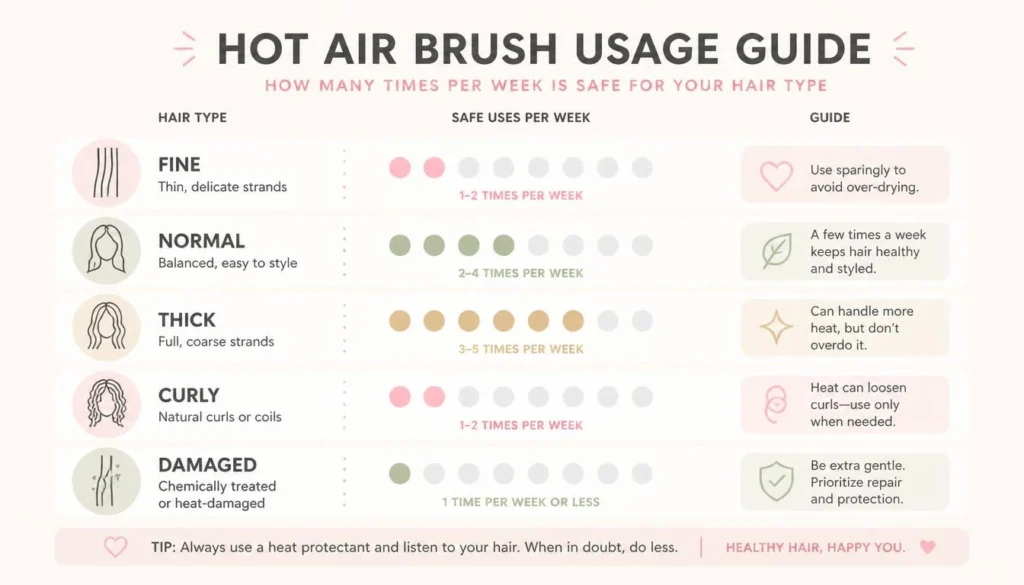
Hot Air Brush Frequency by Hair Type (Quick Chart)
Healthy medium or thick hair tolerates up to three low-to-medium-heat sessions a week, while fragile hair needs fewer. The weekly number drops as hair gets more fragile and as the heat setting rises.
The chart treats your brush’s lowest, middle, and highest settings as Low, Medium, and High, because brands label heat differently.
| Hair profile | Low heat | Medium heat | High heat | Watch for |
|---|---|---|---|---|
| Healthy, medium texture | Up to 3 per week | 2–3 per week | 1 per week, not routine | Dull shine, rough ends |
| Fine or thin | Up to 2 per week | 1–2 per week | Avoid | Limpness, breakage at the ends |
| Thick or coarse (healthy) | Up to 3 per week | 2–3 per week | 1 per week | Frizz, dryness on the lengths |
| Curly or coily | 1–2 per week | 1 per week | Avoid | Loosening curl pattern |
| Color-treated or bleached | 1–2 per week | 1 per week | Avoid | Brassiness, straw-like feel |
| Visibly damaged | 1 every 1–2 weeks, or pause | Pause | Pause | Snapping, spreading split ends |
Save or screenshot this hot air brush frequency chart. It covers how many sessions per week your hair type and heat setting can handle.
These numbers are editorial guidelines, not clinical limits. They sit under the AAD benchmark above, and the American Academy of Dermatology’s guidance on habits that damage hair explains the reasoning behind it. No dermatology source reviewed for this guide gives a hot-air-brush-specific number. Treat the chart as a conservative starting point and adjust by how your hair responds.
How Often Can You Use a Hot Air Brush? Four Things That Change the Answer
Four variables move your limit up or down: heat setting, hair condition, heat delivered per session, and protection. Cutting the heat each session delivers is the fastest way to raise the number of sessions your hair can handle.
Heat setting
Use the lowest setting that still shapes your hair. Dermatology tips relayed by HealthDay include choosing the coolest setting on a styling tool and keeping it from lingering on the hair. health day
Hair condition
Hair that is fine, curly, colored, or bleached has less buffer. A Baylor College of Medicine dermatologist explains that hot tools can break bonds in the hair over time. Chemically processed strands reach that point sooner.
Heat per session
Letting hair partly air-dry first cuts heat time. The AAD advises giving hair time to partially air-dry before styling. Professional brand Sam Villa Pro suggests getting hair at least 80% dry before using a hot brush. As a working rule, make one slow pass per section and never more than two. healthdaysamvilla
Heat protectant
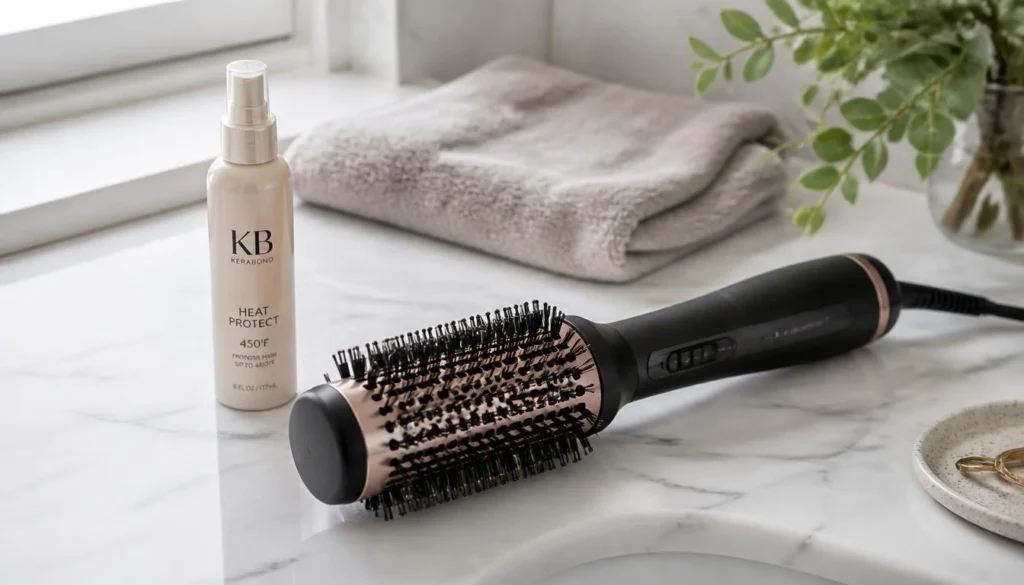
Heat protectant is a spray or serum applied before styling, used to reduce direct heat contact with the hair. Medical News Today suggests pairing heat tools with heat protection products. Do You Need Heat Protectant for a Hot Air Brush? medicalnewstoday
Can You Use a Hot Air Brush Every Day?
You can, but daily use shouldn’t be your default. Daily use stacks heat exposure with no recovery day, which is why dermatology guidance leans toward sparing use of heat tools.
Here is the counterintuitive part. Even the AAD’s older advice for flat irons capped use at every other day on dry hair and low-to-medium heat. No dermatology guidance treats daily heat as a normal baseline. Newswise
If you style most days anyway, follow these steps:
- Drop to the lowest effective setting. Raise it only if your hair won’t shape.
- Start with hair about 80% dry. Less wet hair means fewer seconds under heat.
- Apply heat protectant. Do it every time, including touch-ups.
- Make one slow pass per section, two at most. Stop when the section is dry and shaped.
- Take a heat-free day after every two days in a row. Braids or a loose bun work well.
- Check your hair weekly. If it feels rougher, move to the chart’s limit for your hair type.
For the full heat question, see Does a Hot Air Brush Cause Heat Damage? The Real Answer.
Is a Hot Brush Damaging to Hair?
Repeated heat can damage hair, and a hot brush is a heat tool. How much damage depends on how often, how hot, and how long you style.
A small 2020 study reported by Medical News Today found that women who had used heat styling tools in the past six months were more likely to have microscopic hair changes than a control group. Small studies can’t prove how much damage a hot air brush causes. They do explain why spacing sessions out and keeping heat low are the sensible levers. The broader answer is in the guide linked at the top of this page. Healthline
Signs You’re Using Your Hot Air Brush Too Often
Three signals tell you to cut back: more frizz, rougher ends, and styles that take extra passes to set. Hair that gets harder to style on the same schedule is the earliest practical warning.
| Signal | What it means | What to do |
|---|---|---|
| Soft ends, normal styling time | Green: Your frequency is working. | Keep your current schedule. |
| More frizz, dull finish, extra passes needed | Yellow: heat is building up. | Drop one session a week and lower the heat; see Does a Hot Air Brush Make Hair Frizzy? |
| Straw-like dryness, snapping, spreading split ends | Red: hair is overheated. | Stop heat for 7 days. |
| Heavy shedding or scalp irritation | Not a heat-styling fix | See a dermatologist or trusted stylist. |
Common frequency mistakes
- Pairing extra passes with high heat. Two sessions at high heat can cost more than three at low heat.
- Counting touch-ups as free. Every session adds heat exposure, including a quick root refresh.
- Keeping the same schedule after coloring. Chemically processed hair needs the stricter rows in the chart.
- Skipping protectant on “just one more pass.” Short sessions still apply heat.
7-Day Reset Plan
- Stop all heat for days 1–7. Wear braids, buns, or air-dried styles.
- Use a conditioner-focused wash routine. Keep shampooing gentle and consistent.
- Return on day 8 at one low-heat session. Use protectant and one pass per section.
- Add a second weekly session only after 2 weeks with no warning signs. Stay inside your chart row.
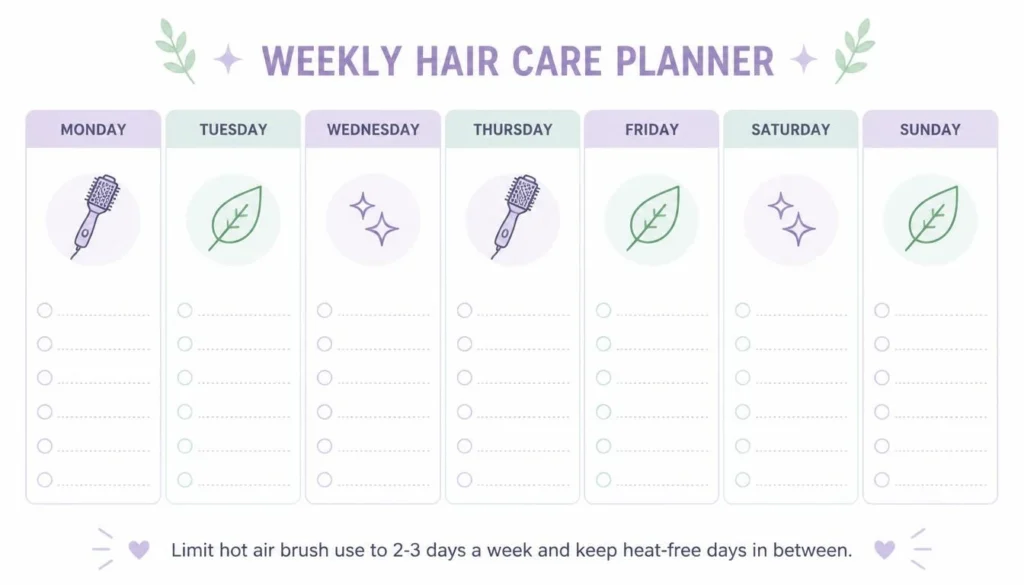
A Sample Week: How to Space Out Hot Air Brush Days
Leave at least one heat-free day between sessions. Spreading sessions across the week lets hair recover between each exposure to heat.
| Day | Healthy medium or thick hair (3 sessions) | Fine or color-treated hair (2 sessions) |
|---|---|---|
| Monday | Full style, low-to-medium heat | Full style, low heat |
| Tuesday | Heat-free | Heat-free |
| Wednesday | Roots-only refresh | Heat-free |
| Thursday | Heat-free | Roots-only touch-up, low heat |
| Friday | Full style | Heat-free |
| Saturday–Sunday | Heat-free | Heat-free |
Stretching a style across days reduces how often you need the brush. How to Make a Blowout Last Longer (Step-by-Step Guide) covers how.
FAQ
Is it okay to use a hot air brush every day?
Daily use is possible but not recommended as a routine. Dermatology guidance leans toward using heat tools as rarely as possible, and a hot air brush still adds heat each time. If you style most days, use the lowest effective setting, apply heat protectant, let hair air-dry partway first, and build in at least two heat-free days a week.
Is a hot brush damaging to hair?
Repeated heat can damage hair, and a hot brush is a heat tool, so frequency and heat level matter. Damage shows up as dryness, frizz, rough ends, and breakage. Keeping sessions to your hair type’s weekly limit, using the lowest effective setting, and applying heat protectant lowers the risk, though no heat tool is completely risk-free.
Is a hot brush worth it?
A hot brush is worth it if it replaces a longer blow-dry-and-style routine and you keep to your weekly limit, because it combines drying and shaping in one tool. It is less worthwhile if you use it daily on fragile hair. Your hair condition and how often you style matter more than the tool’s price.
How long should I wait between hot air brush sessions?
Leave at least one heat-free day between sessions as a working rule. For curly, color-treated, or damaged hair, leave three to six days, which matches the once-a-week ceiling in the chart. This spacing is practical guidance rather than a clinical rule, so lengthen the gap if you notice frizz, dryness, or rough ends.
Should I use heat protectant every time?
Yes. Heat protectant is a spray or serum applied before styling, used to reduce direct heat contact with the hair. Medical News Today advises pairing heat tools with heat protection products. Apply it every session, including quick touch-ups and low settings, because each session adds heat exposure.
Can I use a hot air brush on damaged hair?
You can, but sparingly. Damaged hair has less buffer, so limit sessions to once every one to two weeks or pause while it recovers, use the lowest heat setting, and apply heat protectant. If hair snaps when brushed, shows spreading split ends, or sheds heavily, stop heat styling and ask a stylist or dermatologist.
The Bottom Line: What to Do Next
Find your hair profile in the chart, start at the lower number, and watch for the yellow signals. If your hair stays soft and styles quickly, you’re in the right range. If not, cut one session a week and lower the heat.
Your next steps:
- Already dealing with dryness or breakage? Read Hot Air Brush for Damaged Hair: What Actually Helps (and Hurts).
- Noticing frizz? Check Does a Hot Air Brush Make Hair Frizzy? The Honest Answer.
- Wondering about protection? Do You Need Heat Protectant for a Hot Air Brush?