
You bought a hot air brush for faster mornings, then read one scary comment and started checking your ends. Your worry is fair: does a hot air brush cause heat damage? has a straight answer that depends on a few things you control.
Quick Answer: Yes, a hot air brush can cause heat damage, but mainly when the heat is too high, the hair is too wet, or the same strands get repeated passes. On hair that is about 80% dry, at the lowest effective setting, with heat protectant and slow, steady strokes, the risk is much lower.
What You Need to Know
- Heat damage comes from three things: temperature, water in the hair, and repeated passes or tension.
- Soaking-wet hair is the riskiest starting point. Rough-dry first.
- There is no universal “safe number of days.” Fragile, bleached, or already damaged hair needs fewer sessions.
- Heat protectant helps, but it does not make heat harmless.
- The scorecard below lets you check your own routine in about a minute.
The Short Answer
Can a hot air brush harm your hair? It can, though the cause is usually careless use, not the tool itself. A hot air brush pushes warm air through a bristled head, letting you dry and style hair at the same time.
The American Academy of Dermatology AAD says excessive heat can damage hair of any type. It recommends limiting blow-drying, choosing low or medium heat, and using a product that protects hair from heat. A hot air brush carries the same risks as a regular hair dryer.
Does a Hot Air Brush Cause Heat Damage? The Three Ways It Happens
Heat damage is the loss of moisture and structure in the hair shaft caused by high temperatures, which shows up as dryness, rough cuticles, and breakage. With a hot air brush, it usually arrives through one of three routes.
1. Too much heat
High temperature roughens the outer cuticle layer faster than low temperature does. A 2011 study in the Annals of Dermatology compared hair tresses dried at different dryer distances. Drying for 15 seconds at 5 cm (about 95°C) caused more surface damage than drying for 60 seconds at 15 cm (about 47°C).
That study used a hair dryer on hair samples, not a hot air brush, so treat the numbers as an illustration of the principle. Heat output varies from model to model, so look in your user manual for the exact figures.
2. Water inside the hair
Damp hair is more fragile, since the moisture trapped inside each strand heats up fast. A British Journal of Dermatology report on “bubble hair” described how brief, focused heat on damp hair fibers can damage the shaft from the inside.
That condition has mostly been linked to hot irons. Hot air is less concentrated, but the water principle is the same, which is why stylists say to rough-dry first.
3. Repeated passes, tension, and friction
Pulling a brush through the same section again and again adds mechanical wear on top of heat. The AAD notes that wet hair breaks more easily when combed or brushed. A brush that snags on tangled, damp hair stacks tension on top of warmth.
A Counterintuitive Finding About Drying Time
Here is the surprising part: in that same Annals of Dermatology study, drying with a dryer held 15 cm away and kept moving caused less damage than letting hair air dry. The researchers suggested that long contact with water also stresses hair.
So the goal is “no heat at all.” It is short, controlled, moderate heat applied by a tool that keeps moving.
Hot Air Brush vs Flat Iron vs Hair Dryer: Which Is Gentler?
Tools that press heat onto a narrow strip of hair are generally harsher than tools that move warm air across it. The three tools differ in how they deliver heat:
| Tool | How heat is applied | Main risk |
|---|---|---|
| Hot air brush | Warm airflow plus a brush | Too-high setting, wet hair, repeated passes |
| Hair dryer | Stronger airflow, no brush | Holding it too close or too hot |
| Flat iron | Direct heat from two plates | Concentrated heat on dry hair |
For the AAD, flat irons belong on dry hair at low or medium heat, no more often than every other day. For deeper comparisons, see hot air brush vs. flat iron and hot air brush vs. hair dryer.
Heat Damage Risk Scorecard
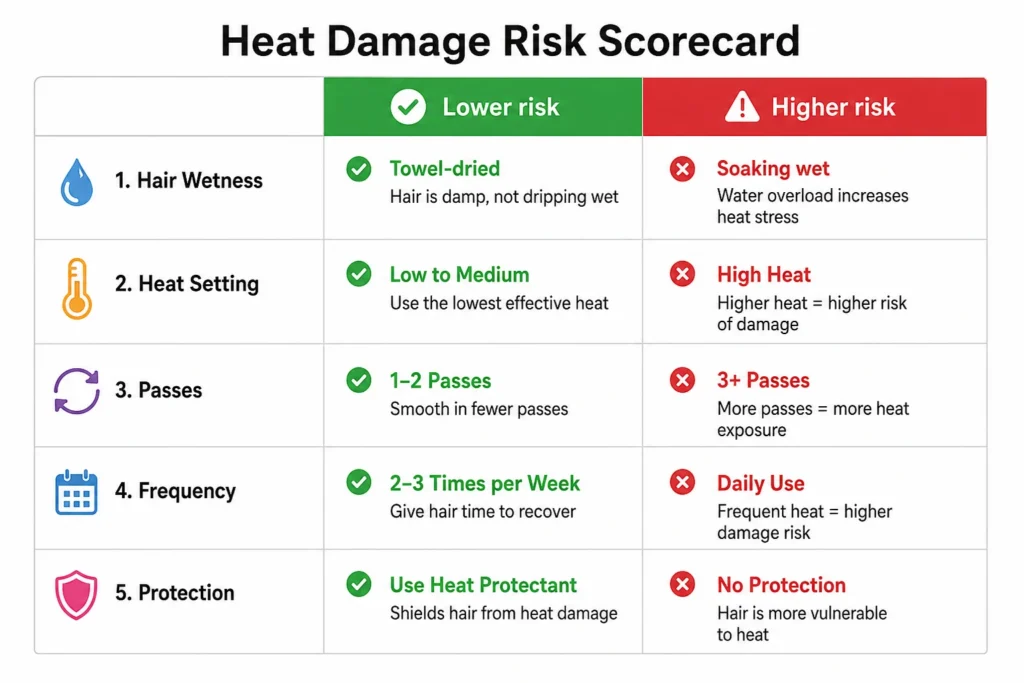
Use this to check your routine. Every row below is something you can control.
| Factor | Lower risk | Higher risk | Why it matters |
|---|---|---|---|
| Hair wetness | About 80% dry (damp) | Soaking wet | Water in the strand heats up quickly. |
| Heat setting | Lowest setting that works | Maximum setting by habit | Higher heat roughens the cuticle faster. |
| Passes per section | A few slow, steady passes | Repeated passes over one spot | Heat and friction add up. |
| Frequency | A few sessions per week | Every day | Damage accumulates over time. |
| Protection | Heat protectant on mid-lengths and ends | None | The AAD recommends heat-protecting products. |
Quick decision tree:
- Is your hair soaking wet? Rough-dry it first, then use the brush.
- Is the setting on maximum? Drop one level and see if it still works.
- Are you going over one section more than a few times? Section smaller and slow down.
- Does your hair have bleach damage, a fine texture, or existing brittleness? Use the lowest setting and fewer sessions.
Save or screenshot this Heat Damage Risk Scorecard. It covers the four habits that decide most heat-damage risk.
Can You Use a Hot Air Brush Daily Without Damaging Your Hair?
There is no authoritative “safe number of days,” so the honest answer is it depends on your hair and your technique. Brand pages give conflicting advice, with some saying daily use is fine at the right temperature and others advising against it for fragile hair.
The AAD’s guidance is useful here: decreasing how many times per week you blow-dry helps limit damage. Healthy, thick hair on a low setting tolerates more sessions. Fine, bleached, or already-damaged hair needs more rest days. Treat daily use as the thing to earn, not the default.
Which Hair Types Are Most at Risk?
Hair that is already weak has the least margin for error. Match your caution to your hair:
| Hair type | Why more care is needed | What to adjust |
|---|---|---|
| Fine hair | Thinner strands heat and break more easily. | Lowest setting, fewer passes |
| Bleached or colored | Chemical treatment already weakens the cuticle. | Low heat, never on soaking-wet hair |
| Already damaged | Little structural reserve left | Reduce sessions; see a hot air brush for damaged hair. |
| Curly or coily | Dryness and breakage show up fast. | Low heat, gentle detangling first |
How to Use a Hot Air Brush Without Heat Damage
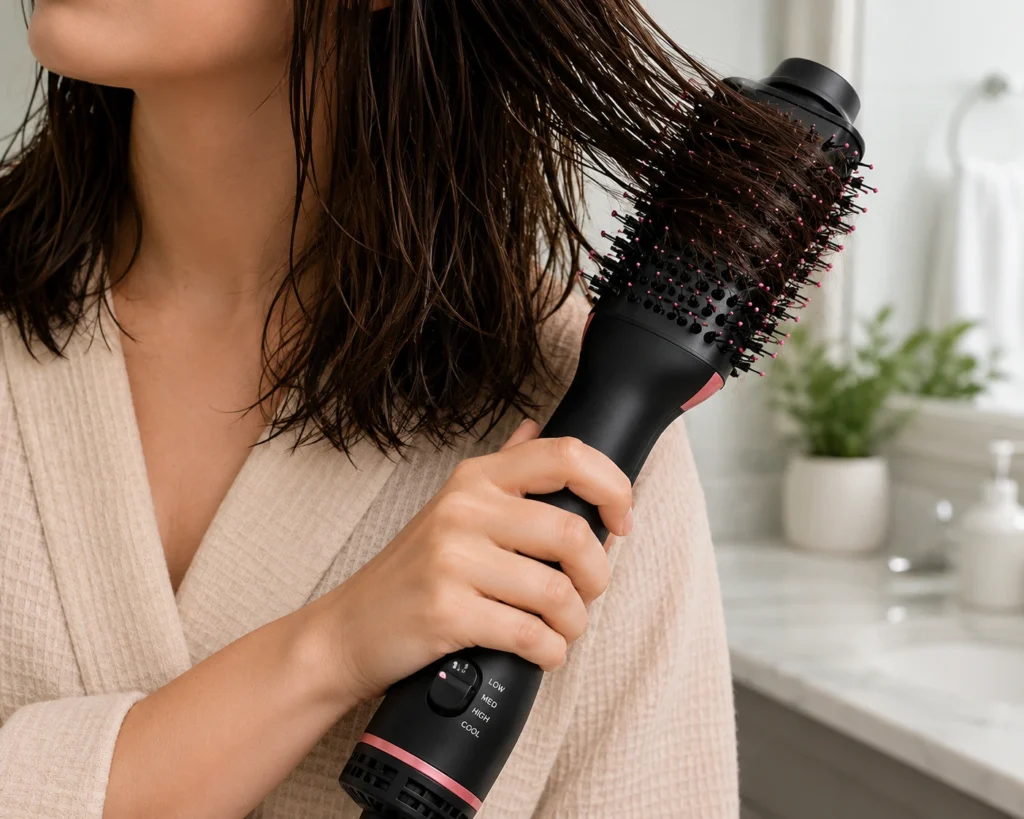
The safest routine is short, low, and steady. Follow these six steps:
- Rough-dry to about 80%. Blot your hair with a towel, then let it air-dry or use a blow dryer until it’s damp but not dripping. Professional tool brand Sam Villa gives 80% dry as its rule.
- Apply heat protectant. Work it through mid-lengths and ends, keeping it off the scalp.
- Split into four sections. Crown, left, right, and back. Clip them up and work with narrow sections of roughly 1–2 inches.
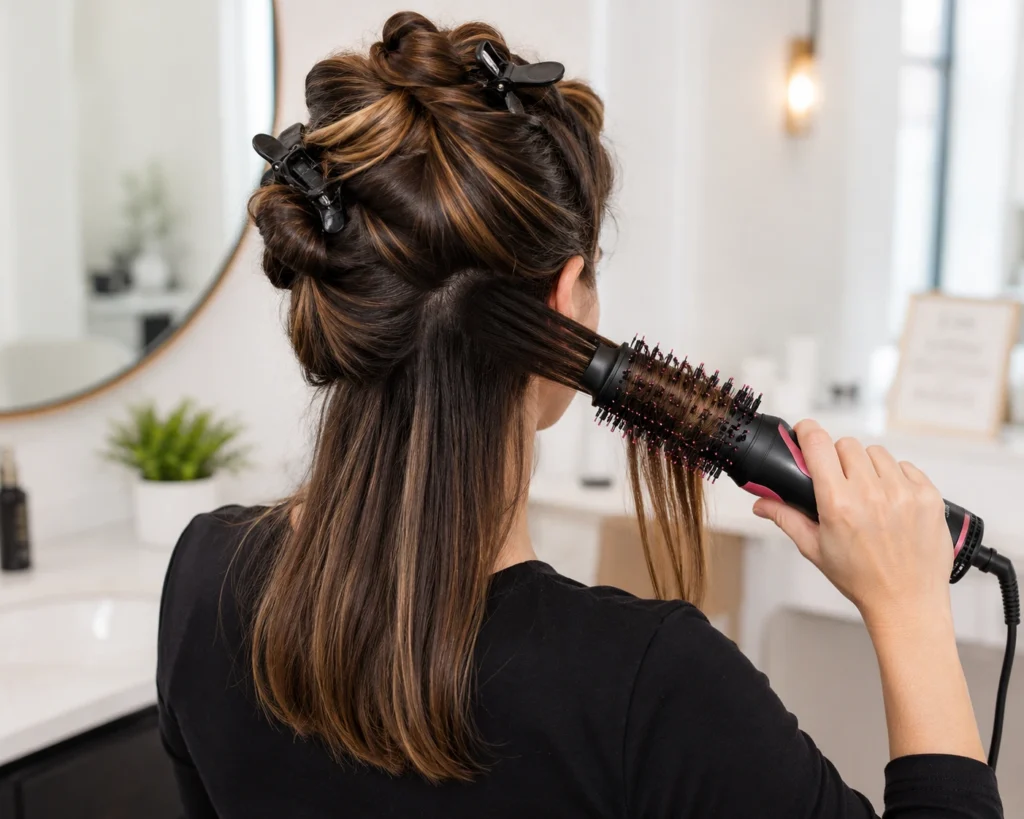
- Start at the lowest setting. Raise it one level only if the hair won’t dry or shape. Check your model’s manual for what each setting means.
- Glide slowly from root to tip. Keep the brush moving. As a practical guideline (not a measured limit), aim for two or three passes per section.
- Finish with a cool setting if your brush has one. A few seconds of cool air helps set the shape. See how to use a hot air brush for full styling steps.
One piece of equipment makes this much easier: a brush with adjustable heat settings.
Common Mistakes That Turn a Safe Tool Risky
A few repeat habits cause most heat damage. Watch for these:
- Starting on soaking-wet hair. A hot air brush is a finisher, not a replacement for a dryer.
- Defaulting to maximum heat. Higher is not faster for every hair type.
- Skipping heat protectant. The AAD recommends a protective product.
- Going over one spot repeatedly. Re-section instead.
- Brushing through tangles. Detangle first to avoid snagging and tension.
Signs Heat Has Already Damaged Your Hair
You can spot damage by the way your hair looks and feels. Check both:
What you can see:
- Dry, split, or frayed ends
- Dull lengths that don’t regain shine
- Frizz that returns right after styling
- Short broken pieces in your brush
What you can feel:
- A rough, straw-like texture
- Hair that stretches or snaps instead of bouncing back
- Stubborn tangles
Heat styling is only one possible cause. Bleach, rough towel-drying, and tight styles also damage hair. The AAD advises seeing a dermatologist if changing your routine doesn’t help, because hair care may not be the root cause.
See a professional promptly if you notice patchy breakage, scalp burns or irritation, or sudden shedding.
FAQ
Is it safe to use a hot air brush every day?
It can be for some people, but there is no universal safe frequency. Healthy hair on a low setting with heat protectant tolerates more use than fine, bleached, or damaged hair. The AAD says reducing weekly blow-drying limits damage, so build in rest days.
Do hot brushes cause heat damage?
They can if the heat is too high, the hair is too wet, or the same strands get repeated passes. Used on damp hair at a low setting with heat protectant, a hot brush is typically gentler than direct-contact tools like flat irons.
Is a hot air brush good for hair health?
No styling tool improves hair health, because hair strands are not living tissue. A hot air brush can be a lower-damage way to dry and shape hair than harsher alternatives if used carefully. The healthiest choice is still using less heat, less often.
Can you use a hot air brush on wet hair?
Rough-dry first. Hot air brushes have less drying power than a regular dryer, and water inside the strand makes heat riskier. Aim for damp hair, about 80% dry, before you start styling.
Can heat damage be reversed?
Damaged strands can’t truly heal, because hair is not living tissue. Conditioners and masks can make hair feel smoother, and trimming removes the worst ends. Cutting back on heat lets new, undamaged hair grow in.
Does heat protectant really work?
It helps reduce the harm of heat, and the AAD recommends using a heat-protecting product. It is a safety layer, not a license for maximum heat. Use it together with lower temperatures, damp hair, and fewer passes.
What to Do Next
Now that you know where the risk comes from, the next step depends on your hair:
- Already seeing dryness or breakage? Read about a hot air brush for damaged hair.
- Want a step-by-step routine? Follow how to use a hot air brush.
- Want the full verdict? Read the pillar guide: Is a hot air brush bad for your hair?
Pingback: Is a Hot Air Brush Safer Than a Flat Iron? 5 Differences
Pingback: Do You Need Heat Protectant for a Hot Air Brush?
Pingback: Can You Use a Hot Air Brush Every Day? 5 Safety Rules