
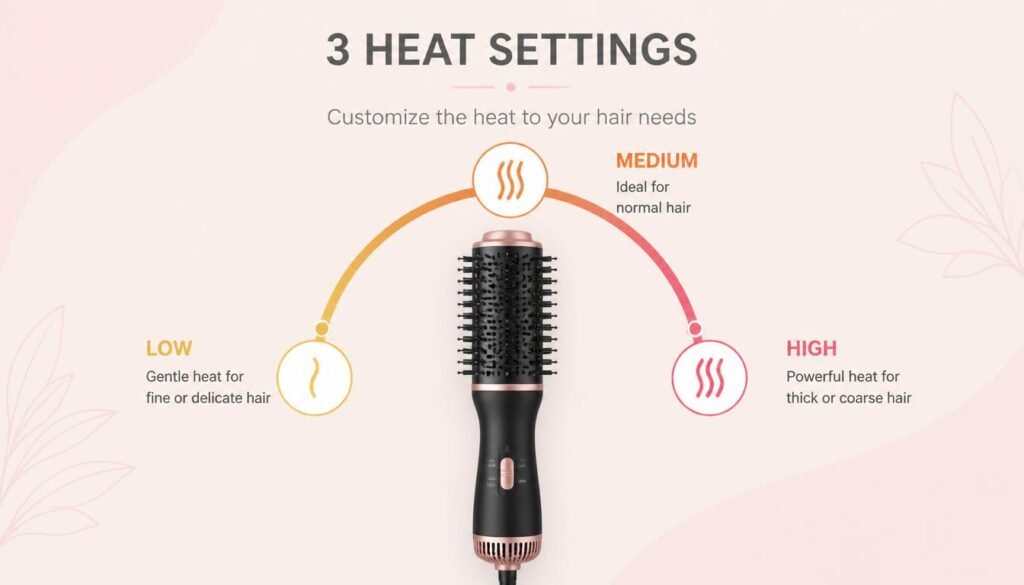
You just unboxed a hot air brush, and the heat button offers three choices with zero explanation. So, what heat setting to use on a hot air brush? Start low. The chart below shows when and how to go higher, and the full picture on heat and your hair is in our guide to whether a hot air brush is bad for your hair.
Quick Answer: Start on your hairdryer’s lowest heat setting and step up one level at a time, only if a section won’t dry in two slow passes. Fine, damaged, or color-treated hair usually stays on low; normal hair is on low to medium, and thick or coarse hair may need high.
What You Need to Know
- Begin every session on the lowest heat setting, then raise it one level at a time.
- Hair type sets your ceiling: low for fine or damaged hair, up to high only for thick or coarse hair.
- Damp (not soaking) hair, heat protectant, and small sections matter as much as the setting itself.
- Settings that are too low can hurt too, because slow drying means more passes and more total heat.
- Hot, squeaky, or scorched-smelling hair means you should drop a level immediately.
Table of Contents
What Is the Safest Starting Setting for a Hot Air Brush?
The safest starting point is the lowest heat setting on your brush. The lowest setting that fully dries your hair is the right setting, and higher is never automatically better.
A hot air brush is a styling brush with a built-in heater and fan, used to dry and shape damp hair in one step. Stylist guidance commonly says to start on damp hair that is about 80% dry, because these brushes lack the drying power of a full-size blow dryer.
The American Academy of Dermatology advises low or medium heat settings plus a heat-protecting product for every hair type. That is why low is the default here and high is the exception.
Hot Air Brush Heat Setting Chart by Hair Type
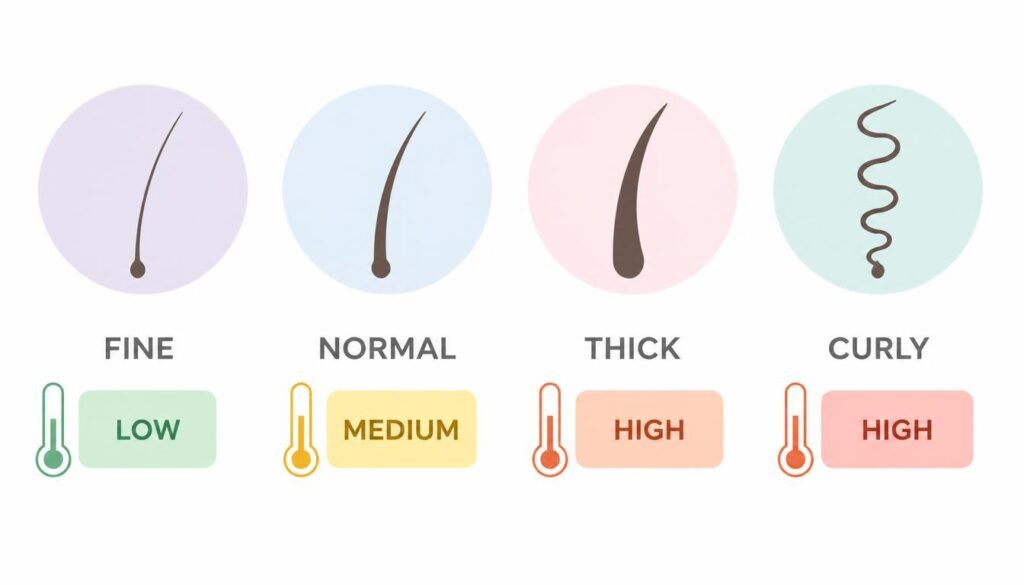
Use this chart to find your starting setting and your realistic ceiling. Your ceiling depends on hair type, and only thick or coarse hair routinely justifies the highest setting.
Brands rarely publish exact temperatures, so the chart uses relative levels instead of degrees. If your brush shows numbers, treat the lowest number as “low.” If it shows a temperature readout, pick the lowest value offered.
| Hair type | Start at | Usual ceiling | Step up only if | Drop a level if |
|---|---|---|---|---|
| Fine or thin | Low | Low to medium | A small section is still damp after two slow passes. | Hair feels hot, looks limp, or squeaks. |
| Normal or medium | Low | Medium | A section stays damp after two passes. | Hair feels hot to the touch. |
| Thick or coarse | Low | High | Smaller sections and slower passes haven’t dried it. | Hair smells scorched or feels rough. |
| Color-treated or bleached | Low | Low to medium | A stubborn section needs a brief pass on medium. | Hair feels dry, rough, or dull. |
| Heat-damaged or breaking | Low | Low | Don’t step up; use smaller sections and extra time instead. | Any snapping or visible breakage |
| Curly or frizz-prone | Low | Medium | A section won’t dry after detangling and two passes. | Frizz increases after drying. |
| Short hair or fine hairline | Low | Low to medium | The back is still damp after two passes. | The hairline feels hot |
Save or screenshot this Hot Air Brush Heat Setting Chart. It covers every hair type from fine to coarse.
Two rows deserve a closer look. For using a hot air brush on damaged hair, never step up. For a hot air brush for frizzy hair, detangle first, because tangles slow every pass and tempt you to raise the heat.
What Heat Setting to Use on a Hot Air Brush? Find Yours in 4 Steps

You can find your setting in about four steps and a few minutes of testing. Test on one small underside section first, so a wrong guess never shows.
- Prep damp, protected hair. Towel-dry, then let hair air-dry or rough-dry until it is roughly 80% dry. Apply a light heat protectant from roots to ends.
- Start on the lowest setting. Pick up a small underside section that fits on the barrel without covering it, and make two slow passes from roots to ends.
- Step up one level only if needed. If that section is still damp after two passes, move up exactly one level and repeat. Never jump straight to high.
- Step back down once it works. When the section dries completely, return to the lower level for the rest of your head. Hairlines are often finer than the back, so they may need less heat.
If your brush has no genuinely low setting, the tool itself may be the problem. We’ll cover options for hot air brushes for damaged hair.
What Are the Signs Your Setting Is Too High or Too Low?
Your hair tells you quickly. Too much heat feels hot, squeaky, or rough, while too little leaves hair damp, flat, or frizzy after you release it.
Too high:
- Hair feels hot to the touch
- A squeaky or straw-like feel
- A scorched smell
- Hair that looks flat or limp
Too low:
- A section is still damp after two passes
- Curl or shape drops within minutes
- Frizz appears after you let go
Here is the counterintuitive part: the safest hot air brush session is the shortest one. According to the American Academy of Dermatology, letting your hair partially air-dry before you style it and cutting down how many times per week you blow-dry both help limit damage. The AAD also says excessive heat can damage any hair type. So the goal is efficient drying at the lowest effective heat, not the lowest heat at any price.
What Do Heat, Airflow, and the Cool Shot Do?
Heat sets how hot the air is, airflow sets how much air moves, and the cool shot sets the shape. They are three separate controls, so raising one rarely means you need to raise another.
Many hot air brushes offer only a heat switch and a fan, but some add a cool button. Hold the barrel in place at the end of a curl or bend, then press the cool shot so the hair cools in its shaped position before release.
If your hair is thick, try smaller sections before raising the heat. For how the fan and heater work together, see how a hot air brush works.
Can I Use a Hot Air Brush Daily?
Daily use is possible but not ideal. The American Academy of Dermatology advises limiting blow-drying and heat tools, so fewer days on low heat is always safer.
Fine, color-treated, and already damaged hair has the least room for daily heat. If you style daily, use the lowest setting that works, apply protectant each time, and stop at the first sign of dryness.
Are Hot Air Brushes Good for Hair?
They can be a reasonable choice, but they are still heat tools. A hot air brush is only as gentle as the setting, the frequency, and the technique behind it.
Brands commonly describe them as gentler than flat irons because heated air replaces a hot plate clamped on the strand. That is a brand claim, not a guarantee. To understand the real trade-offs, read about heat damage from a hot air brush.
How Do You Properly Use a Hot Air Brush?
A proper session takes six actions in order. Damp hair, heat protectant, and sections come before the first pass, not after.
- Dry to about 80%. Towel-dry, then air-dry or rough-dry.
- Apply heat protectant. Use a light formula, roots to ends.
- Clip into sections. Work from the bottom layer up.
- Brush slowly. Glide from roots to ends, lifting at the roots for volume.
- Shape and cool. Turn the ends inward or outward, then use the cool shot.
- Finish dry. Release each section only when it is fully dry.
For the full walkthrough, see how to use a hot air brush, step by step.
Get the Printable Heat Setting Cheat Sheet.
The chart above works best on your phone or taped near your mirror. A one-page version means you never have to guess your setting mid-style.
When Should You Skip the Brush or See a Professional?
Stop using heat if your hair or scalp is telling you something is wrong. Breakage, scalp burns, or sudden thinning need a stylist or dermatologist, not a different setting.
Setting names and strength vary by brand, so check your own manual too. If your hair keeps snapping on low, your hair may need a break from heat altogether.
Frequently Asked Questions
How to properly use a hot air brush?
Start with damp hair that is roughly 80% dry, add heat protectant, and clip your hair into sections. Heat the brush on its lowest setting, then glide it slowly from roots to ends, lifting at the roots for volume. Release each section only once it is fully dry, use the cool shot if your brush has one, and raise heat only if needed.
Can I use a hot air brush daily?
Possibly, but less often is safer. The American Academy of Dermatology advises limiting blow-drying and heat tools, so daily use carries risk, especially for fine, color-treated or damaged hair. If you do style daily, stay on the lowest setting that works, use heat protectant every time, and stop at the first sign of dryness or breakage.
Are hot air brushes good for hair?
They can be gentler than plate-based tools because heat comes from moving air, but any heat tool can dry hair out. Results depend on your setting, how often you style, and your hair’s condition. Low heat, protectant, and fully dry sections keep risk down, while high heat and daily use raise it.
Can I use high heat on wet hair?
No. Very wet hair means the brush works longer, and a high setting concentrates heat on fragile wet strands. Towel-dry and let hair air-dry or rough-dry to damp first, then use the lowest setting that works. A hot air brush lacks the drying power of a full-size blow dryer, so it is a finishing tool.
Do I need heat protectant on the low setting?
Yes. Low heat is gentler, not harmless, and the American Academy of Dermatology advises pairing low or medium settings with a heat-protecting product. Apply a light formula to damp hair from roots to ends before your first pass, so your hair is covered during the whole session without feeling weighed down.
What heat setting to use on a hot air brush for color-treated hair?
Start on low and stay there. Color-treated and bleached hair is more fragile, and the American Academy of Dermatology recommends low or medium heat with protectant for every hair type. Try medium only briefly on a stubborn section, and drop back down if your hair feels rough, dry, or dull afterward.
What if my hot air brush has only one heat setting?
Treat that single setting as your maximum and control exposure instead. Use small sections, keep the brush moving, work on damp (not soaking) hair, and limit passes. If your hair feels hot, squeaks or looks frizzy afterward, the brush may run too hot for your hair, and an adjustable model is the better fit.
What to Do Next
- Learn the full routine in how to use a hot air brush, step by step
- If your hair is already stressed, read about using a hot air brush on damaged hair.
Pingback: Do You Need Heat Protectant for a Hot Air Brush?