
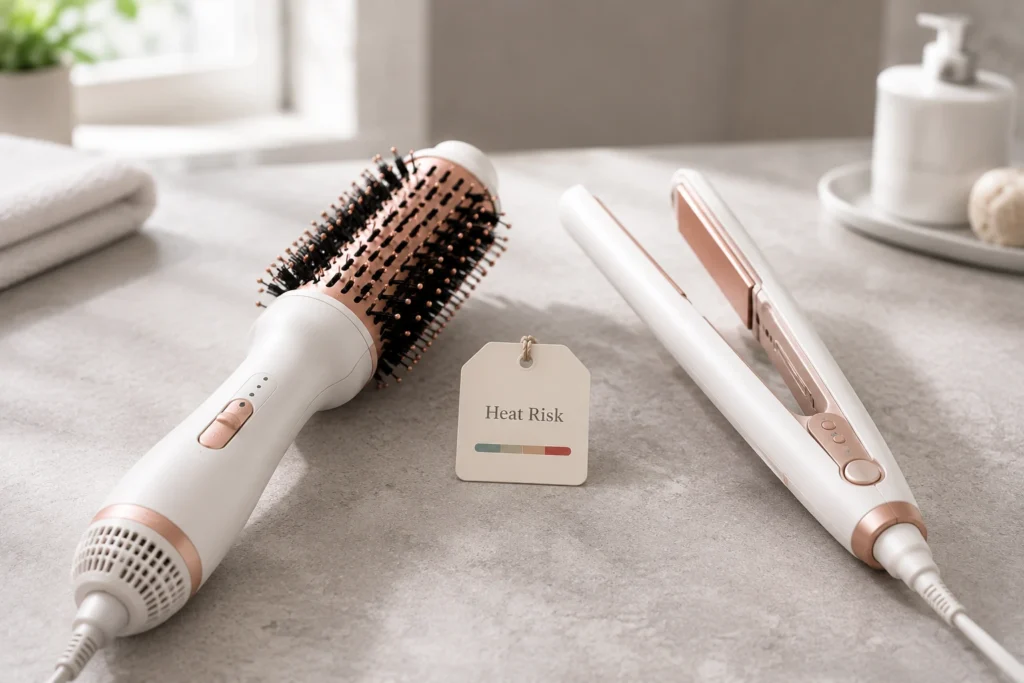
You’re deciding between the flat iron already on your counter and a hot air brush you’re thinking of buying, and you don’t want to trade one kind of damage for another. Is a hot air brush safer than a flat iron? Usually yes, but the gap depends on how you use each tool.
Here, “hot air brush” means the warm-airflow styler covered in our plain-English guide to what a hot air brush is. It does not mean a heated straightening brush or a hot comb.
Quick Answer: Usually yes. A hot air brush warms hair with moving air and applies no clamping pressure, while a flat iron presses hair between plates that many models let you set at 400°F or higher. Both can cause damage, though, especially on wet hair or at high settings, so settings and technique matter as much as the tool.
What You Need to Know
- Is a hot air brush safer than a flat iron? Generally yes, because it heats with airflow and doesn’t clamp or pull strands.
- Damage depends on heat level, contact time, pressure, and moisture, not temperature alone.
- Dermatologists advise using flat irons only on dry hair, on low or medium heat, no more than every other day.
- A flat iron can still be the better choice for very thick or tightly curled hair that must be pin-straight.
- The safest habit with either tool is the lowest heat that works, a protector on, and as few passes as possible.
Table of Contents
The Short Answer: Which Tool Is Gentler on Hair?
Generally, yes. A hot air brush heats hair with warm airflow and never clamps or pulls strands, while a flat iron presses hair between hot plates at higher temperatures. The advantage shrinks on soaking-wet hair or the highest setting, so your habits still matter.
The design of a hot air brush lowers the risk, but it doesn’t remove it. A hot air brush is a round or oval styling brush with a built-in heating element and fan, used to dry and shape hair in one step. A flat iron is a pair of heated plates that clamp a section of hair and are used to press it straight.
What Actually Touches Your Hair in Each Tool?
A hot air brush warms hair with a flow of heated air, while a flat iron squeezes each section between hot plates. That difference in how heat reaches the strand explains most of the safety gap.
How a hot air brush heats hair
The fan pushes heated air through and around the bristles while you brush. Hair is shaped by tension from the brush, not by a plate pressing it flat.
The exact air temperature varies by model. Check your manual or the manufacturer’s spec page for the figure that applies to your brush.
How a flat iron heats hair
Heat passes straight from the plates into the strand, and the clamp adds pressure as you pull the iron down the section. That pressure and pull are why flat irons can stress hair mechanically as well as thermally.
Many flat irons let you dial up to 400°F or higher. A hair-loss specialist quoted by The Healthy (Reader’s Digest) suggests keeping flat irons and curling irons between 200°F and 400°F, depending on how thick your hair is.
The Heat-Risk Scorecard
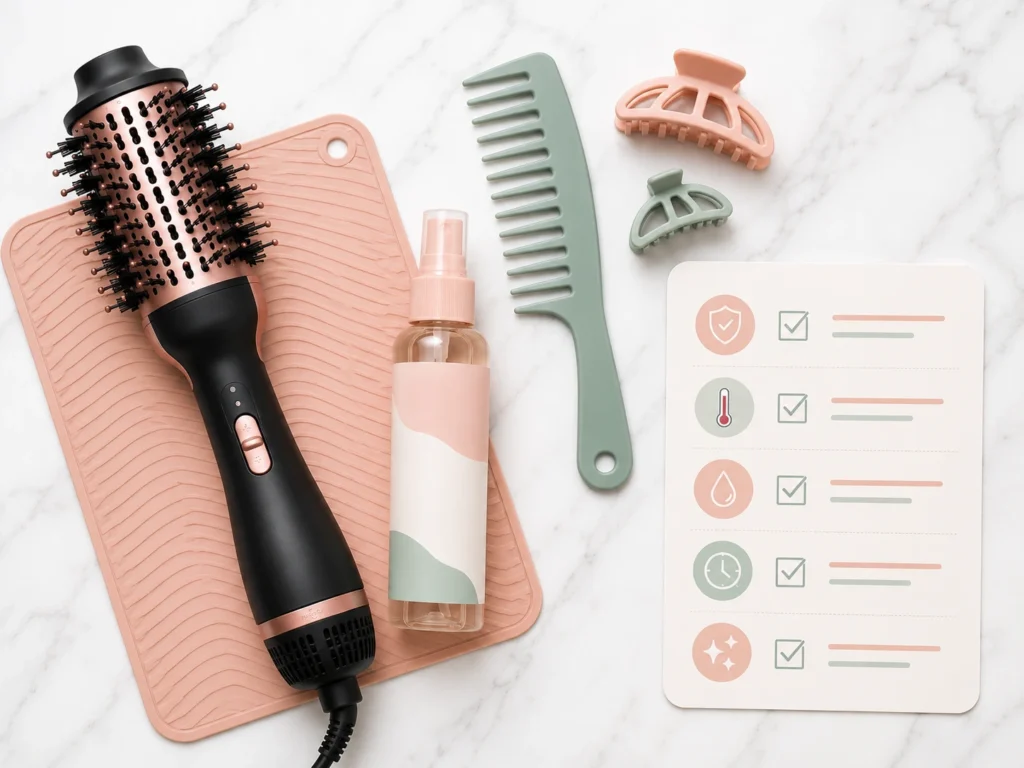
This scorecard compares the factors that decide how much stress each tool puts on your hair. Both tools can cause damage, and the scorecard shows where each one is riskier.
| Risk factor | Hot air brush | Flat iron |
|---|---|---|
| How heat is delivered | Warm moving air | Hot plates in direct contact |
| Pressure on the strand | None built in | Clamp plus pull |
| Heat level | Varies by model (check the manual) | Often adjustable up to 400°F or higher |
| Passes to finish a section | Usually fewer for smoothing, varies by hair | Often more on thick or curly hair |
| Burn zones | Hot barrel and nozzle | Exposed plates near scalp and ears |
| Wet hair | Higher risk at high heat | Avoid entirely. |
| Frequency guidance | Use the lowest setting that works. | American Academy of Dermatology: dry hair, low or medium heat, no more than every other day |
Save or screenshot this heat-risk scorecard: it covers the factors that decide which tool is gentler on your hair.
Why Temperature Isn’t the Only Risk
Heat damage comes from several factors working together: how hot the tool is, how long it stays on the hair, how much pressure it applies, and how wet the hair is. A gentler tool used carelessly can do more harm than a harsher tool used well.
Moisture matters more than most people expect. According to the dermatologist guidance summarized by HealthDay, wet hair breaks more easily when it is combed or brushed. That same guidance says flat irons belong on dry hair only.
A hot air brush is often used on damp hair, so check your manual for the moisture level the manufacturer recommends. High heat on dripping hair is the setup most likely to erase the tool’s built-in advantage.
For a deeper look at how heat harms the hair shaft, read whether a hot air brush causes heat damage.
Is a Hot Air Brush Safer Than a Flat Iron for Fine, Thick, or Curly Hair?
For most hair types the hot air brush is the lower-risk choice, but thick, coarse, or tightly curled hair may push people toward a flat iron. Your hair type changes how much safety you gain and whether the hot air brush can do the job at all.
Fine or thin hair
Fine strands have less mass to absorb heat, so they tend to show damage sooner. A hot air brush on a low setting is generally the gentler fit, and a flat iron should stay at the bottom of its range.
Thick or coarse hair
Thick hair often needs more passes to smooth. If a hot air brush isn’t getting results in one or two passes, resist the urge to raise the heat and keep going.
Curly or coily hair
A hot air brush loosens and smooths curl patterns but may not make tight coils pin-straight. Chasing that look with extra passes and higher heat is where damage accumulates.
Color-treated or already damaged hair
Hair that is already stressed has less room for error, so choose the lowest heat available and cut the frequency. Our guide to using a hot air brush on damaged hair walks through what helps and what hurts.
Burn and Scalp Safety
Both tools can burn skin, and neither is risk-free near the scalp. Flat iron plates are exposed hot metal, while a hot air brush concentrates heat at the barrel and nozzle.
Keep either tool moving and away from your scalp, ears, and neck. Let it cool fully before storing it, and keep it out of reach of children.
When Is a Flat Iron the Better Choice?
A flat iron is the better choice when you need a truly pin-straight finish on very thick, coarse, or tightly curled hair. A hot air brush smooths and shapes, but it won’t always deliver a glass-flat result.
So, is a hot air brush safer than a flat iron for everyone? No. If you need flat-iron results, use the iron at the lowest effective heat, on fully dry hair, with one controlled pass per section.
For a full comparison of results, speed, and styling, read our hot air brush vs. flat iron breakdown.
Common Mistakes That Cancel the Safety Advantage
The most common mistakes are using the highest setting by default, skipping heat protectant, and repeating passes on the same section. Most heat damage comes from habits, not from the tool itself.
- Running a hot air brush on soaking-wet hair at maximum heat.
- Stacking tools, such as drying with the brush and then flat ironing the same day.
- Holding the tool in one spot instead of keeping it moving.
- Styling daily with no recovery days.
- Raising the heat because a section isn’t smoothing, instead of changing technique.
How to Cut Heat Risk With Either Tool
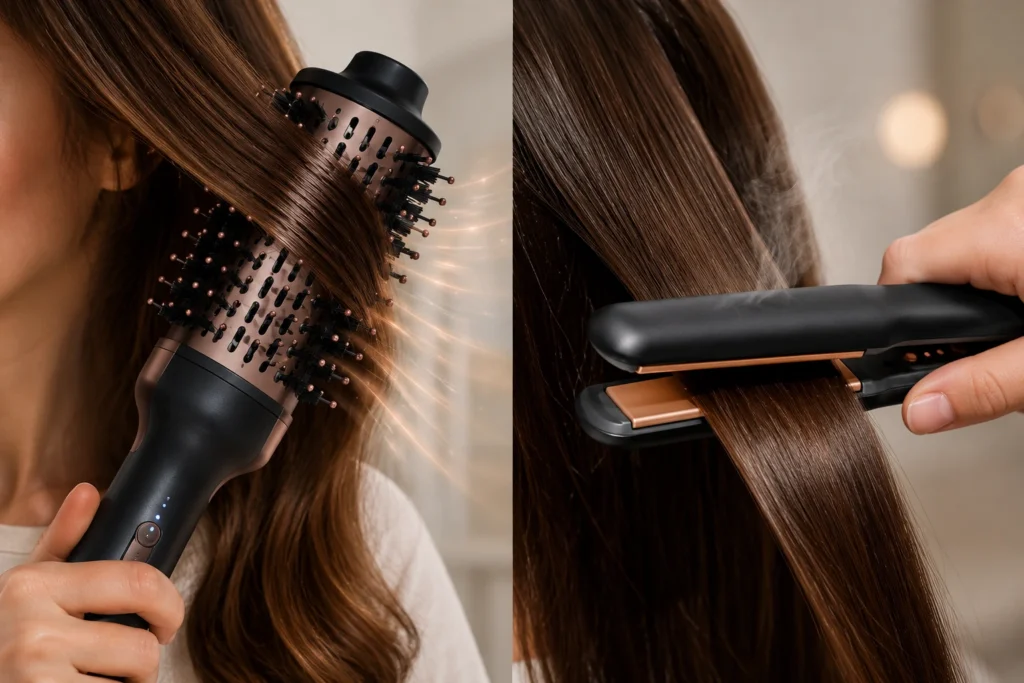
The safest routine uses the lowest effective heat, protectant, controlled passes, and rest days. Following these six steps lowers the risk with a hot air brush or a flat iron.
- Start with clean, detangled hair. Product buildup and knots force extra passes.
- Check the moisture level. Flat irons go on fully dry hair. For a hot air brush, follow the manufacturer’s guidance on damp versus dry.
- Apply heat protectant. Work it through the mid-lengths and ends before any heat touches the hair.
- Choose the lowest setting that works. The American Academy of Dermatology says flat irons should be used on dry hair on a low or medium heat setting, no more often than every other day. See its guidance on styling hair without damage.
- Work in small sections and limit passes. Aim for one or two passes per section. If a third seems necessary, use a smaller section instead of more heat.
- Limit frequency. Keep flat-ironing every day at most, and give your hair rest days when you can.
FAQ
Is a hot brush more damaging than a straightener?
Usually not. A hot air brush heats with moving air and doesn’t clamp hair, while a straightener presses it between hot plates. A heated straightening brush, which is a different tool, sits in between. Damage depends on temperature, passes, and wet hair, so a hot air brush on its highest setting can still cause harm.
What is the healthiest hair straightening method?
The healthiest method uses the least heat: air-drying or heat-free styling when possible. When you do use heat, choose the lowest setting that works, apply protectant, style dry hair with a flat iron, and limit frequency. The AAD says flat irons should be used no more often than every other day.
Do hot air brushes damage hair?
They can, though usually less than hot contact tools. Damage comes from high heat, wet hair, repeated passes, and daily use. Used on a lower setting with protectant and in moderation, a hot air brush carries a lower risk. Read our guide on whether a hot air brush is bad for your hair for the full picture.
Is it better to use a hot comb or a flat iron?
Neither is a hot air brush, so this sits outside this article’s scope. Both press hair with heated metal. The safer choice is the one with controllable, adjustable temperature, because a tool you can’t set to a lower heat leaves you less room to protect your hair.
Is a hot air brush safe to use every day?
Daily use raises cumulative stress on any heat-styled hair. A hot air brush on a low setting is generally gentler than daily flat ironing, but dermatologists advise using heat tools as infrequently as possible. Alternate heat days with air-dried days, and use a protectant every time.
Do I need heat protectant with a hot air brush?
Yes, it is a sensible precaution. A heat protectant adds a barrier layer before heat reaches the hair, and it matters most on fine, color-treated, or already damaged strands. Apply it to the mid-lengths and ends before styling, and reapply each time you use heat.
What to Do Next
Now that you know where each tool stands, these three steps are the natural next ones. Is a hot air brush safer than a flat iron for your hair? Start by reading how heat styling affects your hair, then see what helps and hurts damaged hair. Finally, compare styling results between the two tools.
For the dermatologist guidance behind these tips, see the American Academy of Dermatology’s styling and hair damage guidance.