
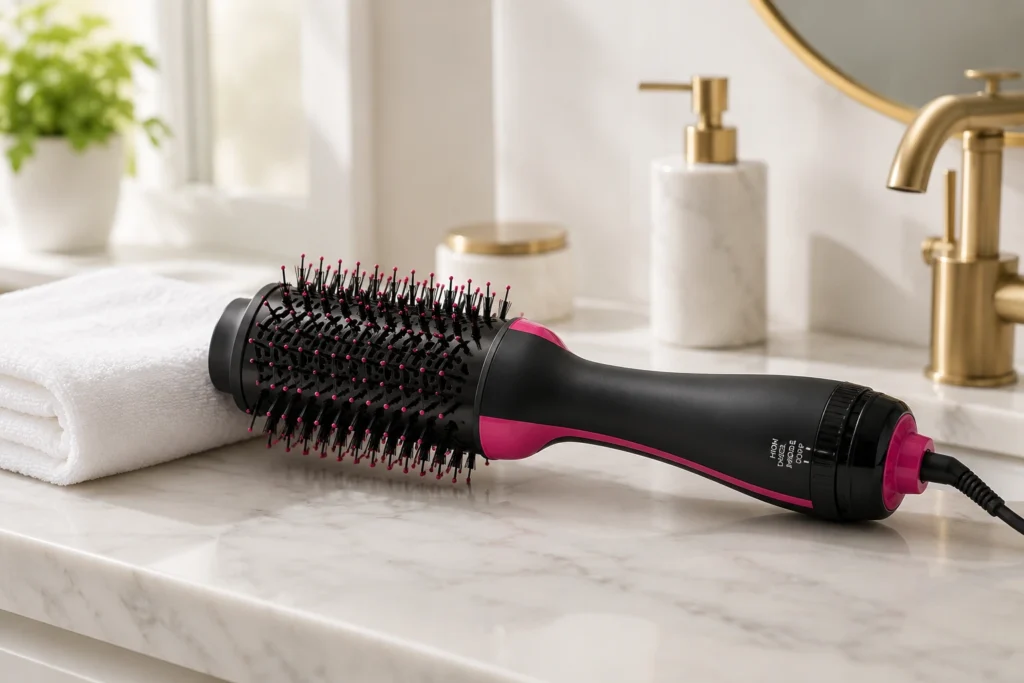
Your hot air brush keeps turning off halfway through a blowout, and one side of your hair is still damp. Most of the time this is a safety cut-out or a power problem you can sort out in about ten minutes. The chart below shows which one you have. This post is part of our Hot Air Brush Maintenance & Troubleshooting: The Ultimate Guide.
Quick Answer: A hot air brush keeps turning off most often because blocked airflow triggers its built-in overheat protection. Other common causes are a damaged cord, a loose outlet or power strip, and a hair wound inside the brush head. Unplug it, let it cool for about 30 minutes, clean the intake, and test it in a wall outlet.
Table of Contents
What You Need to Know
- A hot air brush that restarts after cooling is usually protecting itself and is not dead.
- Blocked airflow (lint or wound hair) is the most common trigger.
- The timing of the shut-off points to the cause. See the chart below.
- Shutting off when you move the cord means stop using it.
- A burning smell, sparks, or a repeatedly tripping breaker means stop immediately.
Why Your Hot Air Brush Keeps Turning Off: The 7 Causes
A hot air brush shuts off because something interrupts its power or because its heat protection trips. Overheat protection is a safety feature, so a brush that cuts out and then restarts after cooling is often working as designed. Work through these causes from most to least common.
1. Blocked air intake or filter
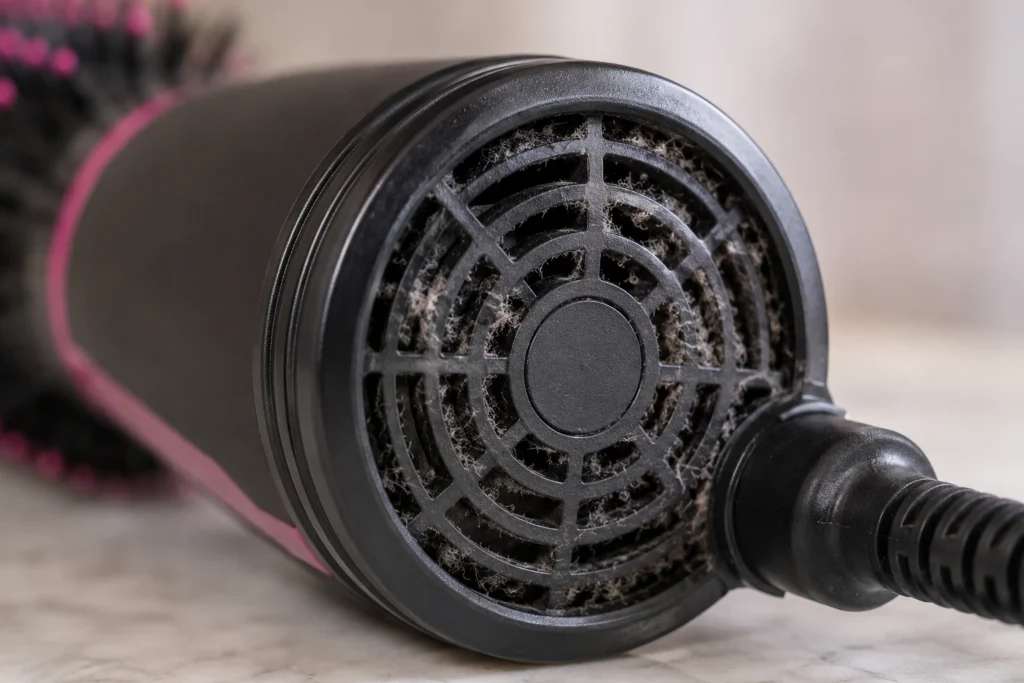
A clogged intake is the most common cause. The brush pulls room air in through a rear grille, warms it over a heating element, and pushes it out through the barrel. When lint blocks the grille, heat builds up inside, and a thermal protector cuts the power.
Fix: Unplug the brush and let it cool. If the rear cover on your model lifts off, take it off and sweep the lint away with a clean, dry, soft-bristled toothbrush. Our guide to cleaning a hot air brush covers the full process.
2. Hair or debris wound in the brush head
Hair wrapped around the base of the bristles or barrel restricts the airflow at the outlet. The motor works harder, and the unit heats up faster.
Fix: Unplug and cool the brush first. Then lift the wound hair with the tail of a comb and pull it free. Check the area around the barrel base too.
3. A heat and speed mismatch
Heat is carried away by moving air. High heat paired with low airflow is the hardest, fastest way to trip overheat protection. Lowering the heat alone won’t help if the intake is blocked, because the airflow problem remains.
Fix: Start on low or medium heat and step up one setting at a time. Our how to use a hot air brush guide explains each setting.
4. A damaged or twisted power cord
A frayed or kinked cord can lose contact when it moves. If the brush cuts out when you bend or turn the cord, the wiring is the likely cause. A brush that shuts off when the cord moves should be replaced, not repaired.
Fix: Run your fingers along the cord, checking especially near the plug and where the cord enters the handle. Don’t tape a damaged cord.
5. A loose outlet, power strip, or extension cord
Heat tools draw a lot of power. A worn outlet, a thin extension cord, or a crowded power strip can interrupt it. Electrical safety groups such as the National Fire Protection Association publish guidance on extension cord and power strip use with heating appliances.
Fix: Plug the brush straight into a wall outlet. If it works there, the strip or cord was the problem.
6. Tripped plug protection or an overloaded circuit
Some hair tools come with a plug that has built-in shock protection, often with TEST and RESET buttons. If yours does, it can cut power without warning. Bathroom outlets often have the same protection built in.
Fix: Press RESET on the plug or outlet. If it trips again immediately, stop using the brush.
7. A worn switch, thermal fuse, or motor
Internal parts wear out. In some designs, a thermal fuse fails permanently after one overheat event instead of resetting.
Fix: If the brush shuts off instantly, makes odd noises, or smells hot even after you’ve cleaned it, the internals are likely worn. Replacing it is the safer choice.
Symptom Chart: When It Shuts Off Tells You Why
Matching when your brush cuts out to a cause is the fastest way to diagnose it.
| When it shuts off | Most likely cause | First fix |
|---|---|---|
| Within 1–3 minutes, restarts after cooling | Blocked intake and overheat cut-out | Unplug, cool, and clean the filter. |
| Instantly on switch-on | Outlet, plug, or internal switch | Try another wall outlet; inspect the cord. |
| When you move or bend the cord | Damaged cord or plug strain | Stop using it; replace the brush. |
| Only on high heat or high speed | Setting and airflow mismatch | Lower the heat; clear the intake. |
| Only in one room or outlet | Circuit, GFCI, or power strip | Plug straight into a wall outlet. |
| Burning smell, sparks, or breaker trips | Electrical fault | Stop using immediately. |
These are typical patterns, not lab-tested figures. Your manual’s guidance comes first.
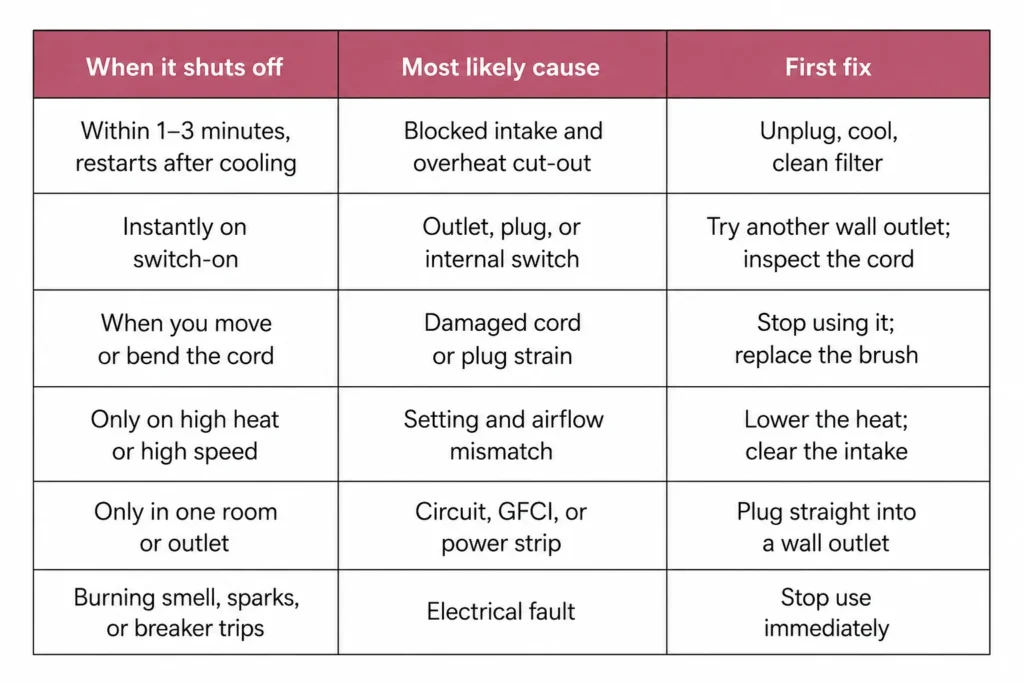
Save or screenshot this symptom chart. It covers every common shut-off pattern in one view.
What Is the 10-Minute Fix Routine?
This routine rules out the common causes in order. Expect roughly 10 minutes of active effort, plus the time the brush needs to cool down.
- Unplug and let it cool for about 30 minutes. A cool-down is a common rule of thumb, so check your manual for your model.
- Inspect the cord and plug. Spend a minute running your fingers along the whole cord, checking for kinks, bare spots, or a loose plug.
- Clean the intake and filter. Spend about two minutes removing lint with a dry, soft brush.
- Clear the brush head. Spend about two minutes pulling out any wound hair.
- Test in a wall outlet. Use a different room if you can, and skip power strips and extension cords.
- Run it on low heat and low speed for 3 minutes. If it holds, the airflow was the issue.
- Step up one setting at a time. Note which setting makes it cut out. That points to the cause.
Hot Air Brush Shutting Off vs. Tripping the Breaker
If only the brush stops, the problem is the brush or its plug. If lights or other devices also go dead, the problem is the circuit.
| What you notice | Likely meaning | What to do |
|---|---|---|
| Only the brush stops; the outlet still works. | Brush, cord, or plug protection | Follow the 10-minute routine. |
| Lights or other devices also lose power. | Tripped breaker | Reset the breaker, then test the brush on another circuit. |
| Breaker trips again right after reset. | Electrical fault | Stop using it and call an electrician. |
| Works fine in another room | Overloaded circuit | Move other high-power devices off that circuit. |
Is It Normal for Hot Tools to Turn Off by Themselves?
Yes, in some cases. Many heat tools include overheat protection, and some also include an idle timer. A tool that shuts off to protect itself is behaving as designed, but one that shuts off repeatedly needs a closer look. Check your manual for an auto-off feature. If the same thing happens with a full-size dryer, see our guide on a hair dryer that keeps shutting off.
Common Mistakes That Make It Worse
Restarting it again and again can hide a real problem. Turning the brush back on the moment it cuts out heats it up again before it has cooled. Other common mistakes include
- Taping a damaged cord instead of replacing the brush
- Using a thin extension cord or crowded power strip
- Ignoring lint on the filter because “it still works”
- Winding hair so tightly that it jams the barrel
- Running high heat first, then wondering why it shuts off
When to Stop Using It and Replace It
Stop using the brush right away if you notice a burning smell, sparks, a melted plug, a damaged cord, or a breaker that keeps tripping. Don’t open the casing yourself. Contact the maker about warranty cover, and check the U.S. Consumer Product Safety Commission for recalls on your model.
If cleaning and testing don’t fix it, a replacement is the safer route. When you’re ready to compare options, our hot air brushes roundup lists models worth shortlisting.
How to Keep It From Happening Again
A few habits prevent most shut-offs.
- Clean the filter after every few uses.
- Remove wound hair after each session.
- Coil the cord loosely instead of wrapping it around the handle.
- Store the brush cool and flat.
- Look for a recognized safety mark, such as UL, on the label. Check UL’s site for what the mark means.
FAQ
Is a hot air brush bad for hair?
A hot air brush is generally gentler than a flat iron when used on low or medium heat. Damage depends on temperature, how long you hold it in one spot, and how often you style. Use a heat protectant and keep the brush moving. Is a hot air brush bad for hair?
What should I do if a hair dryer keeps tripping the breaker?
Unplug the dryer, reset the breaker, and plug it into a different circuit. If the breaker trips again, stop using the dryer. It may have an internal fault. If it only trips with other high-power devices running, the circuit is overloaded. Repeated tripping means you should call an electrician.
Do hot tools turn off by themselves?
Yes, many do. Hair dryers, hot air brushes, and straighteners often have overheat protection that cuts power when internal temperature rises. Some also have an idle timer. A tool that cuts out once and restarts after cooling is usually behaving normally. Frequent or sudden shut-offs point to a clog, power issue, or worn part.
Do straighteners turn off by themselves?
Many straighteners include an auto shut-off that turns them off after a set period of inactivity, commonly for safety. Check your model’s manual for the exact time. If a straightener shuts off during use, check the cord and outlet first, because a loose connection can mimic an auto-off.
Why does my hot air brush turn off after a few minutes?
A hot air brush that stops working after a few minutes is usually overheating. A blocked intake or hair wound in the head traps heat until the thermal protector cuts power. Unplug it, let it cool, clean the filter, and test it on low heat. If it keeps happening, the internals may be worn.
Can I reset a hot air brush?
Most hot air brushes have no reset button. They reset on their own once they cool. If your brush has a plug with TEST and RESET buttons, unplug it and press RESET, then plug it back in. If the plug trips again right away, stop using the brush.
What to Do Next
Once your brush is running again, these are the logical next steps:
- Learn the full routine in our guide to cleaning a hot air brush.
- Check your technique in our guide on how to use a hot air brush.
- Need a new one? Compare options in our hot air brushes guide.
Pingback: Hot Air Brush Maintenance & Troubleshooting: Complete Guide